Sunday, April 17, 2016

A weekend in Ronda


One fine weekend we took a break from work-life at the molino, and we loaded up the bikes and cycled to Ronda, a beautiful city with an incredible flamenco tablao (venue where flamenco music and dance is performed). A ride to Ronda, approximately 46km distant, didn't sound too bad, and the weather looked to be beautiful, so off we went! We even left our rain gear behind for a change! Ah, sunny Spain!


The first 10km from the molino to the village were scenic, but TOUGH! It takes about 1-1/2 hours for us to bike it ... And that's only about 6-1/2 miles!! Once we made Gaucín it was fairly easier riding, with lots of long gentle climbs and descents. And the scenery:


was fantastic! Huge sweeping views of the Ronda mountains (known locally as 'La Serranía de Ronda'), and numerous pueblos blancos (white villages) tucked in here and there. The picture above shows Jubrique on the left and Genalgaucil on the right (later, we visited Genalgaucil - a beautiful wee village with lots of sculptures around). In the valley below is the river that runs past our molino, the Rio Genal. 


Captured above is one of the lovely pueblos blancos - Algatocín - that we passed through the route.


These were some of the best roads we've ridden since leaving the States. They had everything a cyclist dreams of: beautiful scenery, pavement of superb quality, and generous shoulders for easy passing. If you like sweating a lot while cycling up and down mountain roads- we highly recommend this part of Spain for cycle touring!


Look at that shoulder!


We stopped for a quick look around some prospective properties for our future music school and coffee shop, and were quite taken with San Isidoro. It's a wee rough at the moment, but with a little polishing - and a roof - it could be a real gem!


The landscaping needs a refresh, but the views are to die for!
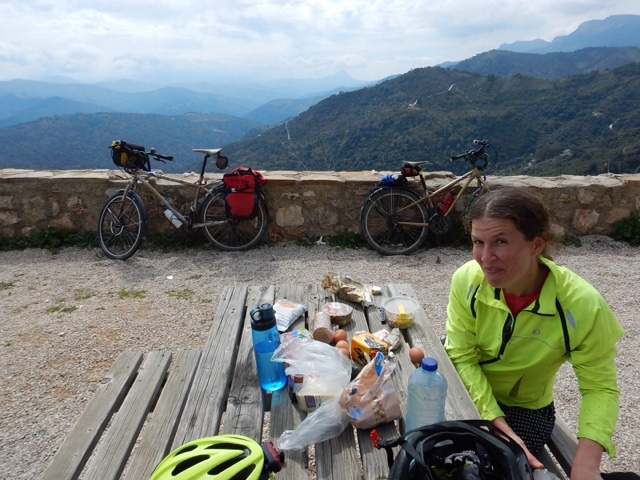

Bringing back fond memories of our bike tour in Scotland, we stopped at a mirador (scenic overlook) for lunch. Olives, boiled eggs, crackers, aged queso de cabra de España  ... All the great things needed to fuel two touring cyclists!


Late in the evening we arrived in Ronda, and jostled a couple miles down (and we mean DOWN) a cobblestone road to our hostel. And, don't you know, it was once a molino (mill), too! Up the gorge from the hostel is the Puente Nuevo (New Bridge) of Ronda, and what a bridge! The Puente Nuevo was started in 1751, and is now one of the most recognizable features of Ronda. It connects the old fortified city to the expanded new city. 


One can walk from the bottom of the gorge up to Ronda, and up it is! In our short stay at the molino we walked this route several times, and felt it each time! 


The bridge took 42 years to build, and fifty workers died during the construction. There's a room in the center, just near the top, that has been used for a variety of purposes. The most notorious use of the room was as a prison, and during the Spanish Civil War both sides used the room as a torture chamber ... And both sides claim to have thrown prisoners from the window to the gorge bottom below. 


This is the church of Santa María la Major. 


The interior was quite impressive. The wealth displayed in the altarpieces and decoration was extordinary. It brought to mind the richer and more glorious days of Spain's past, when the wealth of their vast colonies in the Americas was pouring in, fueling the once giant empire. Near the entry way of the church a portion of its wall was removed to allow the onlooker a glimpse into the church's long history. 


As mentioned in a previous post- churches in southern Spain were often built over and/or from existing mosques.  In the photo above, you can see distinctly arabesque patterns that reflect its Moorish origin. 


We walked a bit further and came across yet another catholic church- la Iglesia del Espíritu Santo. This church was completed in 1505, the same year that Queen Isabel died. We were able to climb to the bell tower, where we were almost struck deaf by the 5 pm chimes. 

Here they are from a little ways away, and about an hour later!


Ronda is a strategically located city. Thought to have initially been founded by the early celts, it was later a Roman outpost, and then was taken by the Moors in the 700's. Being built on a cliff offers a major perk- build fortified walls along the other edges and you have a stronghold against invaders!


This photo shows the remains of such walls. Unfortunately this stategy did not work out so well for the Moors in1485, when they were attacked by Marquis de Cádiz. The Catholic attackers cut off their water supply and forced the thirsty Moorish population to surrender.  

Below you can see the remains of the Arab baths of Ronda, reported to be the best preserved in Spain. 


We learned that in Muslim culture, cleanliness and personal hygiene are of high importance. One must cleanse and purify before prayer, and routine prayer occurs  five times daily. These baths, dating to the 11th century, were thus a very vital part of daily life at that time. These baths are located near the entry to the fortified old city, and travelers would bathe before entering the gates to the city. 


boB, being a sweet and witty gentleman, makes friends easily, as witnessed below. A beautiful housecat comes to the window upon hearing boB's curious meows, and a loving friendship is formed. 


We trekked all over Ronda and discovered many winding narrow street and a few less common trails on its outskirts. We even made it to the bottom of the gorge in several places. 


At the 'secret mine' (not so secret anymore really, and not actually a mine anyways, but that's what it's called), we walked down the dark zigzag steps through the carved edge cliff to meet the waters of the river below. According to legend, this secret military structure was built by a Muslim king in order to secure access to water from within city walls. According to the same legend, slaves would form a human chain to bring water from the river up the 80 meters climb to the village.


Kinda creepy down here ...
it was a relief to meet daylight again.


Having received the recommendation from Francisco, Melinda's most excellent flamenco teacher, we took in two spectacular shows Ronda's tablao, El Quinqué. According to Fransicso, Ronda is 'una ciudad del flamenco". At El Quinqué, the guitarist, two singers, and the incredible dancer all had us at the edge of our front row seats.


We also saw an phenomenal solo flamenco guitar performance by a local teacher- 


We were sad when the weekend came to a close and it was time to depart. 

On Sunday morning, about 10k outside of Ronda we stopped at a wee restaurant (Venta La Vega) for a second breakfast (pan tostada con aceite, tomate y ajo, por supuesto). And wouldn't you know, the timing was perfect- it had just started to RAIN as we pulled up! 


And we weren't the only ones with that idea! The whole cafe was filled with Spanish cyclists dodging the weather in the only restaurant for miles, well, for kilometers!


When we left the Venta, we smiled and gave each other a pat on the back for having had such good fortune: it had stopped raining!


And the scenery was getting better and better! But little did we know what waited ahead!


The clouds opened up and we rode miles and miles in the cold driving rain. With no rain gear. And hardly enough clothing to keep us warm. Cuz, you know, this is southern Spain!!! People don't get hypothermia here, right? 


We were greatly relieved to find a small Spanish "lunch box" ~20 km down the road in Cortez de la Frontera. (You might recall from the Scotland posts that we used bus stops for shelter from the rain, and we took to callig them "lunch boxes". Thankfully, they have them in Spain, too!) We picnicked with gourmet wet peanuts and chocolate. It was divine. Ish. 


The rain finally did let up and we dried out a bit in the light breeze and a lot of climbing to get back to Gaucín. 


Another 10 km down the steep mountain side and up the dirt track and we were sure glad to make it back home to our cozy casita! Soggy bike shorts are simply no fun. But, all in all, small doses of misery make the commonplace seem miraculous! Ah, the bliss of taking warm shower, and of later of sitting next to the wood stove with a little glass of wine- these simple things give even greater pleasure after a bout of cycling ill-prepared through the freezing rain!


Friday, April 15, 2016

Life at the Molino

We thought we'd give you all another peak at our life here on the Molino Taponero. It's been good, hard, busy, fun. Our hosts are fantastic folks, and we feel fortunate to have landed here with them. They have been extremely accommodating and have taught us a lot about Spanish culture and about running the wool mill. Wow, it takes a lot of work to keep this Molino going! 


Here is part of the showroom at the Molino. Sooo much lovely wool! We spent several hours in here picking out a couple of nice things for ourselves and for family as a way to remember our time here. 


A close-up of one of their soft and cozy blankets. The colors are a perfect reflection of Andalucia...


This photo was taken at the large gate where we cut our very first portion of the fire break. Molino Taponero was previouslly  a flour mill along the Rio Genal and there were many donkey tracks connecting it with nearby villages and with other mills. Sadly there was a fire in the 1970's and it fell into ruins. Later on, Paul purchased it with a vision of creating a wool mill. After years of renovation and rebuilding, the WWII-era looms we brought in from Yorkshire and the weaving began! The looms are now electric rather than water-powered, but the original waterways that run underneath the Molino can still be seen. It is truly a magical place.


We spent most of our work time cutting firebreaks on steep hillsides. The pic above was taken near the end of our stay, on one of the last few days that we were cutting firebreaks. boB is standing under a cork oak, which grow very well here, and shows off the day's work - a pile of foliage to be burned! 

Firebreaks, by Spanish law, have to be twenty meters wide and run along all the property lines. In our case, a firebreak had been previously cut several years prior and thus required trimming of new growth. Much of this firebreak was only ten meters wide, so we had to widen it by stripping and additional 10 meters of virgin growth to the ground. We figure we cut well over two hundred meters of new firebreak, and we cleaned up a total of four hundred meters of old firebreak. Well, something like that. Anyway, it was a lot and sweaty hard work that resulted in many an injury!


But no injuries from the chainsaw, thankfully!


Break time! Cutting firebreaks is hard work, and we stop frequently to refuel. Here's boB digging in the backpack for treats to eats!


 Nutella and crackers, Nutella and strawberries, Nutella and chocolate, Nutella and .... Just about anything! 

Cutting firewood. These are eucalyptus logs. 


We got creative stacking firewood one day. There's a LOT of it to stack, and we had to go around a bed that has a poppy planted in it. We built it a wee too high, and the whole stack collapsed about twelve seconds after we snapped this pic! We set it up again, but a bit lower. It's a little bit of firewood artwork for our hosts to enjoy until they need to burn it.


Part of cutting firebreaks is disposing of the cut foliage. Funny thing is that the way to get rid of it is to burn it! We had lots of "burning days" in different parts of the property, and one of the most frequent was in the lower car park by the house. The pic above shows us burning a huge pile of eucalyptus and cottonwood branches. That fire went for hours and hours, and the pile stayed hot for several days afterward!


It was a lot more exciting to burn on the hillsides. You see, the areas that we cut are somewhat remote, ad hauling the cut foliage out is much too difficult. So we built the burn piles in strategic locations where adjoining forest wouldn't be burned, and we made sure that the ground around the burn pile was completely scoured of flammable material. For the most part, it worked well. There were a few fires that got too high and actually scorched the oaks and olives uphill. Oops! Well, they'll recover next year...

One one of the biggest burning days we had a total of fourteen burn piles going. We'd let one of them die down a wee before starting another, but we typically had three or four going at the same time. We  were busy hopping back and forth to tend them, add more material, contain any escapes, and grab a drink of water! 


Burning was hot-hot-hot!! It's scorching work, and we even ended up with burn holes in some of our clothes! It all went well, and we didn't have any out of control situations that we couldn't tame


Here's a burn on a perfect burning day - it was drizzly and cool, and the ground was flat and covered in green grass. 


Burning is filthy work! We normally looked like this after burning days!

And at 2pm, after a hard day of hot work...


Cerveza española! Què refrescante! Qué rica!

And we did have some fun, too...


In our off time, there was lots of time for music study, and with the good weather, plenty of wide open space to play in. 


We had some furry company at the molino: Frankie. She's an ancient kitty, and not too good at grooming herself. We brush her a fair bit, give her lots of food and love, and she loves our company. 


We like having her around, and we'll miss her when we go!

We bought work clothes at a second-hand shop, and they got pretty used-up. boB's shirt got to smelling so bad that washing it didn't really make a difference, and we decided to celebrate our last day of work by using the shirt as a rag for starting a fire!


Ta da! Next stop for the shirt is a bucket of diesel fuel, then a pile of dead trees, then a match! A fitting end...

A little ways from here is a village called Algatocín, and there is a brilliant store that Paul and Dawn have affectionately named "Harrod's".


 Harrod's, if you don't know, is the famous department store in London that sells a absolutely everything from sushi to pianos to diamond rings to couches, and everything in between! 


Our local "Harrod's" isn't quite that fancy and doesn't have pianos, but it does have everything else, including salt cod. We didn't try it, although we were curious. We were in there one day when a fellow walked in with a chainsaw. He walked out with part that he needed for his chainsaw, as well as a bag of tomatoes and a leg of ham!


This is the vinegar section. Just down the aisle is the cleaning products, and those shelves go on for miles! 

Paul and Dawn love to go hill walking, and they invited us pn several walks with them. They like to explore around Gaucín, stopping first for a coffee and pan tostada (delicious Spanish toast often served with garlic, tomato, and olive oil) before heading down a hill into the woods. 


These are cork oaks. Notice how the lower part of the tree is dark and smooth? That's where the bark was harvested, probably last year. The recently harvested trunk has a coppery appearance. 


Go that way.


Here's a magnificent view to the south-west of Gaucín. 


boB and Paul on a road north of the village. 

There was a fellow herding goats while we on the walk with Paul and Dawn:


This is looking to the north, roughly. Over boB's left shoulder is the valley that we rode through on our way home from our weekend bicycle adventure to Ronda. 

We took a hike one day to the village of Genalgaucil, and on the way we discovered that we share a unique talent:

The road where we live is inhabited mostly by English expats who've retired to southern Spain, and we got to meet quite a few of them on Easter weekend. Lots of the English expats from the village came down when the neighbors, Kit and Penn, hosted an Easter Bakeoff contest. It's a delight day of delectable yumminess! 

Here's the table full of goodies, overseen by one of the two judges:


Our entry is on the square rectangle pan second in from the front corner. It was a made-up-on-the-fly mixture of meusli, honey, chocolate, and nuts. We called them "mud balls." Aaaaand we didn't win the bake-off...


Kit (Paul and Dawn's neighbor) is a musician, so lots of his friends came bearing instruments! We joined in and sang along to old David Bowie songs and all sorts of other classic pop songs! 


One of the neighbor girls dressed up the dog. Super cute!


Here's our wonderful hosts, Paul and Dawn. What fun folks, and if you are ever in the area you must look them up for a visit. 

We biked to Casares one Saturday for coffee. Long way to go for coffee, but totally worth it. 


Casares is one of the most photographed white villages in Spain. It's a very old town, and the remains of the moorish fort are located on the highest point (on the right). There's also a church built over the mosque, which is quite common for this area. When the Catholics evicted the Muslims from Spain they built churches over the mosque sites, often times using the minaret and converting it to a bell tower. 


Back at our own village...


Here's boB overlooking Gaucin. 

We're going to miss our little corner of Southern Spain. It's beautiful here, the people are wonderful, and the weather has been lovely! We hope we can come back again sometime....